
Our clients have done well this quarter. The ongoing strength of the US dollar was the main story of the first quarter. The US Dollar gained 9.3% versus the Canadian Dollar and 12.7% against the Euro. Condor's clients benefited from the stronger US Dollar as the majority of equities held by our clients are in US stocks. Diverging policies from central bankers with respect to interest rates was the primary reason for the rising US dollar. The US Fed Reserve Bank is signaling that they are poised to begin an interest rate tightening cycle due to better economic data. Europe is entering a period of lower rates as the European Central Bank is starting a quantitative easing program. Here in Canada, The Bank of Canada cut interest rates due to slackening economic growth. All things being equal, higher interest rates and a stronger economy tend to attract investments resulting in higher exchange rates.
Although our clients saw their portfolio values increase, stocks were relatively flat for the quarter, not withstanding their trading with increasing volatility. The S&P 500 increased fractionally (+0.4%), while the Canadian market (S&P / TSX) was up 1.8% reversing some of the decline from the previous six months. The Canadian bond market returned 4.2% as it benefited from the surprise interest rate cut by the Bank of Canada.
US economic growth was positive during the first quarter, but was not as robust as the prior three quarters. Economic activity was impacted by the West Coast port strike and unusually cold weather. This will translate into earnings growth being a little slower than previously forecast. Companies with big international exposure will also see earnings impacted by a stronger dollar which will hurt both sales and margins.
Lower energy prices detracted from the aggregate S&P 500 earnings number, as energy companies realized lower revenues and profits. On the other hand, companies with significant energy input costs have yet to see the benefit of lower commodity prices. Companies that are net energy users, typically hedge oil and gas costs six to twelve months out. These companies will benefit from lower energy prices in the second half of the year as the hedges roll off. We recently saw the first example of this when Carnival Cruise Lines reported better than expected earnings, primarily related to lower energy costs. For 2015, this will result in the S&P 500 earnings recovering some of the earnings lost from the energy producing companies.
Equity markets remain fairly valued, being neither cheap nor expensive. Markets that are fairly valued, with average economic growth (2.0% - 3.5%) should see stock prices increase close to the long term average of 7 - 8%. S&P 500 returns were flat during the quarter, but this follows positive returns in every quarter of 2014. The S&P 500 appears to be consolidating last year's gain resulting in a churning type of market. The volatility in the first quarter is probably a good indication of what to expect for the remainder of the year.
With the Fed on the cusp of its first interest rate hike in many years, we would expect that stock volatility will increase. While there has been significant analysis of when the Fed will institute the first rate hike, there has been little discussion as to the type or timeline for subsequent rate hikes. We believe that interest rate hikes will be at a measured pace (0.25% per rate hike) and continue at a slow and gradual pace. We anticipate the Fed's future action will be data dependent. If the economy continues to experience strong growth, rates will continue to increase. If growth lags, rate increases will be put on hold. We do not believe that rate hikes will cause major problems for the economy or the financial markets as interest rates are currently near zero. A cumulative rate increase of 1.0% will still leave interest rates below what is considered to be neutral and will remain economically stimulative.
The Bank of Canada lowered the overnight lending rate in January by 0.25% due to a sluggish economic outlook related to lower oil prices. The rate cut took everyone (including us) by surprise, resulting in strong bond returns in the first quarter. Our current thoughts are that the Bank of Canada is unlikely to change interest rates in the short-term. With the current low level of interest rates, bond returns will remain in the low single digit range.
US dollar strength should persist, albeit not to the same degree as the last four months. US GDP growth is stronger than Canadian GDP growth and this situation should continue through the remainder of 2015. The US economy is benefiting from accelerating job growth, stronger US auto production and increased housing activity. Canada on the other hand is facing economic challenges from a combination of layoffs associated with lower oil prices and a peaking housing market. This potentially leads to higher interest rates in the US with the Bank of Canada having more of a neutral bias on rates.
Depressed oil prices are also impacting the Canadian dollar US dollar exchange rate. Lower oil prices result in less (US $) revenues for energy companies. As Canadian energy producers convert less US dollar revenues into Canadian dollars (to cover their costs), there is less demand for Canadian dollars. The Canadian dollar has been viewed by some financial investors, as a “petro currency” resulting in the dollar moving in tandem with oil prices. Persistent oil price weakness has translated into persistent Canadian dollar weakness. If the price of oil rebounds significantly, there would be a reversal of the recent Canadian dollar weakness. Our ability to predict oil production is limited due to the uncertainly of global conflicts and of OPEC oil quotas.
We continue to believe that stocks are the most attractive asset class, although we expect stock volatility to be higher and stock returns to be lower as compared to the last few years. While stock price variability will increase, we currently do not envision a stock market decline of greater than 10% as economic growth is still positive and stock valuations are not expensive. Bonds will continue to yield positive returns, but in a low interest rate environment, returns are unlikely to be as robust as equities.
Thursday, April 23, 2015

Thursday, January 15, 2015
Q4 2014 Commentary
2014 was a good year for Condor Asset management's clients with returns that were superior to both
the Canadian stock and bond markets. Condor's client’s portfolios were well positioned to benefit
from US dollar and US stock market strength.
We anticipate that 2015 will be another positive year for both stocks and the US dollar. US GDP growth, the driver of global macro growth, is forecasted to be approximately 3.0%. In contrast, the current growth prediction for Canada is an expansion of 2.0%, and for Japan and the Euro zone to grow by 1%. Positive global growth combined with low inflation sets a positive tone for global stock markets, but to a lesser degree for the bond markets. Economic expansion will be reinforced by the recent drop in oil prices.
Oil prices declined from a high of $107 in mid 2014 to below $55 per barrel by year end. Supply has outpaced demand for a considerable time however the focus has been on the ability to withstand supply interruptions related to countries experiencing political turmoil. Towards the end of the year, some of these concerns dissipated as additional supplies came on stream. Libya increased production from 250,000 barrels / day in June to 900,000 barrels / day by October. Iraq also shipped more crude and Iran has benefitted from a partial lifting of the oil embargo. The biggest sustained contributor to the increase in 2014 supply has been the relentless increase in North American production due to the shale revolution. Demand this year has also not been as robust as originally forecast. All this is to say that supply turned out better than anticipated while demand was less than expected.
In response, there has been an orderly downslide in the price of crude beginning over the summer months. A November OPEC meeting which failed to resolve the excess supply situation, precipitated a significant decline in oil prices in a relatively short period of time. As OPEC’s swing producer, Saudi Arabia has the biggest influence over supply matching demand. They chose not to cut their production levels to accommodate other members who were over shipping. A lack of consensus on how to curtail supply by OPEC members, Russia and Mexico left supply at levels that were greater than demand. Increasing demand or decreasing supply is the only way for a market to return to equilibrium. While it is difficult to predict exactly how this plays out, it is unlikely there will be a quick resolution. Demand growth will continue to move upwards, but in a slow and orderly fashion. Current low oil prices may result in consumption increasing slightly faster than expected, however demand growth tends to be a gradual process.
Energy companies have begun to cut back their exploration budgets as new development is deemed uneconomic at current prices. This will not result in an immediate decrease in production, but will ultimately slow the pace of supply growth. Projects currently underway will continue as the majority of costs associated with these projects are front end loaded. Alternatively, the undertaking of new projects is more likely to be put on hold, given the current market supply glut.
While lower oil prices might not be good for firms involved in energy extraction, it is positive for consumers, global growth and inflation. Net oil imports in the US, Japan and Europe represent 1.2%, 3.0% and 2.0% of respective GDP. Consumers in these countries will be the prime beneficiaries of lower oil prices. Declining energy costs will be additive to GDP growth in these countries by anywhere from 0.4% to 0.8%. Estimates are that the average American family will save $400 to $800 this year, a portion of which will translate into additional consumer spending.
Lower oil prices will also result in lower inflation and inflation expectations allowing most central bankers to keep interest rates low. The US will be the exception to this stable interest rate world. As US economic growth picks up, it is anticipated that the Fed will raise interest rates sometime during 2015. The added benefit to economic growth and consumer confidence from lower oil prices could lead the Fed to act earlier than previously thought. Faster economic growth in the US versus the rest of the world combined with higher US interest rates should result in continued US dollar strength.
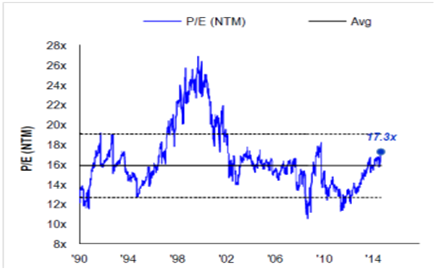
We anticipate a good year for the stock market. We do not foresee a global recession in the short term. As the stock market is neither cheap nor expensive (Charts 2 & 3), we anticipate US earnings gains of 8% translating into an 8 - 10% gain for the US stock market. A plausible scenario of faster than predicted GDP and earnings growth would translate into US stocks rising more than 8-12%. The US stock market should perform better than the Canadian stock market as Canadian earnings will not grow as fast as US earnings. The Canadian stock market is over exposed to the energy sector (Chart 1) which will act as a headwind for income growth.
CHART 1: Energy as a % of the S&P TSX Index
 Source: BMO, HIS Global Insights
CHART 2: P/E for NEXT TWELVE MONTHS
 Source: J.P. Morgan and Bloomberg
CHART 3: PRICE / BOOK Source:
 J.P. Morgan and Bloomberg
US family debt is at its lowest level in 10 years. Total US household debt, when measured as a share of disposable income has fallen from 135% in 2007 to 108% in September 2014. This compares to a current reading for Canadian household debt of 167%, which is the highest in the developed world. Healthier US consumer balance sheets, combined with cheaper gasoline could provide a boast to consumer spending. As a reminder, the US consumer accounts for 2/3 of the US economy. Due to the high level of debt in Canada, consumers are not as well positioned to increase spending.
As previously stated, interest rates are forecasted to rise in the US. This will create headwinds for bond returns as rising interest rates are negative for bond prices. The Canadian bond market will perform a little better than its US counterpart, as we are not forecasting a rate increase from the Bank of Canada in 2015. Assuming relatively flat interest rates, Canadian bond returns will still be in low single digits. CHART 3: PRICE / BOOK Source: J.P. Morgan and Bloomberg
While there is a perception that rising interest rates are negative for the equity markets we do not believe it is justified based on the current scenario. History suggests that initial rate hikes do not necessarily derail equity markets. US interest rates are rising due to a strengthening US economy. US interest rates are only forecast to increase 0.5% - 1.0% next year, which should not significantly impact the economy or the stock market. We are aware that rising stock volatility will accompany the anticipated Federal Reserve rate increase. We witnessed this towards the end of 2014 with the end of quantitative easing. The stock market did rise, but the market had an almost 10% correction before rebounding. We used this correction as opportunities to put cash to work.
While we believe that 2015 will provide investors with positive returns, it does not mean that investing in the financial markets is without risk. Although the past year is considered a “bull market” it was not accompanied by typical investor euphoria. This particular bull market almost has a stealthy characteristic to it. It appears as if the only time that the market is widely discussed in the popular media is when the stock market declines. On the other hand, the majority of Wall Street Strategists have forecasts with stocks gaining 8 – 12% during 2015. The assumptions underlying these forecasts are not overly aggressive.
Another macro risk is the moderation in Chinese economic growth. China is experiencing a reduction in infrastructure spending, a primary driver of Chinese GDP gains over the last two decades. This reduction is presumably a long-term change, but current investment levels are reasonable for the foreseeable future. We are also monitoring the Chinese housing industry for signs of a bubble, but currently do not anticipate that it will have a meaningful negative impact on the economy.
With oil around $50 per barrel, a number of undercapitalized, over levered companies will go bankrupt. We have already started to see this play out as some of the smaller exploration companies have cut dividends and / or slashed exploration budgets. Companies going into chapter 11 will ultimately result in their assets landing in stronger hands as they are bought out of bankruptcy by better capitalized firms. While headlines related to these types of events are never pretty, it is nothing more than the market working to sort itself out, albeit in a somewhat disorderly fashion.
Political instability resulting from lower oil prices are a more concerning risk that is challenging to model or predict. The consequences could be regime change, war, revolt or a myriad of other events. For example, a country such as Venezuela where the majority of government revenues comes from oil revenues will find their spending constrained. Does that translate in their selling less discounted oil to Cuba and China? Does this weakening of finances increase the likelihood of regime change in Venezuela? If they decide to ship less oil to Cuba, what are the implications for Cuba and the leadership there? Did lower oil prices have an influence on the normalization of relations between the US and Cuba? How do governments respond to increasingly unbalanced budgets? Is there anything to stop Russia from invading Azerbaijan or Kazakhstan? What are the implications from the decline in the Ruble and the currencies of other oil producing states? As can be seen from preceding list of potential political events there is a whole host of outcomes not all of them good or easily predictable. We will be closely following the geopolitical climate in 2015 as it relates to global markets.
Global GDP will grow in excess of 3%. The decline in energy prices will be additive to consumer spending growth and will provide a tailwind to further GDP growth. Inflation will not be a huge factor, and again will be aided by the drop in energy prices. Global interest rates will largely remain flat, except for in the US where economic growth is accelerating. Stock picking and being in the right sectors (and avoiding the wrong sectors) will be a critical component to navigating the current choppy investment climate. We continue to believe that fundamentally sound investments will continue to be beneficial for our clients. Feel free to contact us to discuss if your investments are properly positioned.
We anticipate that 2015 will be another positive year for both stocks and the US dollar. US GDP growth, the driver of global macro growth, is forecasted to be approximately 3.0%. In contrast, the current growth prediction for Canada is an expansion of 2.0%, and for Japan and the Euro zone to grow by 1%. Positive global growth combined with low inflation sets a positive tone for global stock markets, but to a lesser degree for the bond markets. Economic expansion will be reinforced by the recent drop in oil prices.
Oil prices declined from a high of $107 in mid 2014 to below $55 per barrel by year end. Supply has outpaced demand for a considerable time however the focus has been on the ability to withstand supply interruptions related to countries experiencing political turmoil. Towards the end of the year, some of these concerns dissipated as additional supplies came on stream. Libya increased production from 250,000 barrels / day in June to 900,000 barrels / day by October. Iraq also shipped more crude and Iran has benefitted from a partial lifting of the oil embargo. The biggest sustained contributor to the increase in 2014 supply has been the relentless increase in North American production due to the shale revolution. Demand this year has also not been as robust as originally forecast. All this is to say that supply turned out better than anticipated while demand was less than expected.
In response, there has been an orderly downslide in the price of crude beginning over the summer months. A November OPEC meeting which failed to resolve the excess supply situation, precipitated a significant decline in oil prices in a relatively short period of time. As OPEC’s swing producer, Saudi Arabia has the biggest influence over supply matching demand. They chose not to cut their production levels to accommodate other members who were over shipping. A lack of consensus on how to curtail supply by OPEC members, Russia and Mexico left supply at levels that were greater than demand. Increasing demand or decreasing supply is the only way for a market to return to equilibrium. While it is difficult to predict exactly how this plays out, it is unlikely there will be a quick resolution. Demand growth will continue to move upwards, but in a slow and orderly fashion. Current low oil prices may result in consumption increasing slightly faster than expected, however demand growth tends to be a gradual process.
Energy companies have begun to cut back their exploration budgets as new development is deemed uneconomic at current prices. This will not result in an immediate decrease in production, but will ultimately slow the pace of supply growth. Projects currently underway will continue as the majority of costs associated with these projects are front end loaded. Alternatively, the undertaking of new projects is more likely to be put on hold, given the current market supply glut.
While lower oil prices might not be good for firms involved in energy extraction, it is positive for consumers, global growth and inflation. Net oil imports in the US, Japan and Europe represent 1.2%, 3.0% and 2.0% of respective GDP. Consumers in these countries will be the prime beneficiaries of lower oil prices. Declining energy costs will be additive to GDP growth in these countries by anywhere from 0.4% to 0.8%. Estimates are that the average American family will save $400 to $800 this year, a portion of which will translate into additional consumer spending.
Lower oil prices will also result in lower inflation and inflation expectations allowing most central bankers to keep interest rates low. The US will be the exception to this stable interest rate world. As US economic growth picks up, it is anticipated that the Fed will raise interest rates sometime during 2015. The added benefit to economic growth and consumer confidence from lower oil prices could lead the Fed to act earlier than previously thought. Faster economic growth in the US versus the rest of the world combined with higher US interest rates should result in continued US dollar strength.
We anticipate a good year for the stock market. We do not foresee a global recession in the short term. As the stock market is neither cheap nor expensive (Charts 2 & 3), we anticipate US earnings gains of 8% translating into an 8 - 10% gain for the US stock market. A plausible scenario of faster than predicted GDP and earnings growth would translate into US stocks rising more than 8-12%. The US stock market should perform better than the Canadian stock market as Canadian earnings will not grow as fast as US earnings. The Canadian stock market is over exposed to the energy sector (Chart 1) which will act as a headwind for income growth.
CHART 1: Energy as a % of the S&P TSX Index
CHART 2: P/E for NEXT TWELVE MONTHS
CHART 3: PRICE / BOOK Source:
US family debt is at its lowest level in 10 years. Total US household debt, when measured as a share of disposable income has fallen from 135% in 2007 to 108% in September 2014. This compares to a current reading for Canadian household debt of 167%, which is the highest in the developed world. Healthier US consumer balance sheets, combined with cheaper gasoline could provide a boast to consumer spending. As a reminder, the US consumer accounts for 2/3 of the US economy. Due to the high level of debt in Canada, consumers are not as well positioned to increase spending.
As previously stated, interest rates are forecasted to rise in the US. This will create headwinds for bond returns as rising interest rates are negative for bond prices. The Canadian bond market will perform a little better than its US counterpart, as we are not forecasting a rate increase from the Bank of Canada in 2015. Assuming relatively flat interest rates, Canadian bond returns will still be in low single digits. CHART 3: PRICE / BOOK Source: J.P. Morgan and Bloomberg
While there is a perception that rising interest rates are negative for the equity markets we do not believe it is justified based on the current scenario. History suggests that initial rate hikes do not necessarily derail equity markets. US interest rates are rising due to a strengthening US economy. US interest rates are only forecast to increase 0.5% - 1.0% next year, which should not significantly impact the economy or the stock market. We are aware that rising stock volatility will accompany the anticipated Federal Reserve rate increase. We witnessed this towards the end of 2014 with the end of quantitative easing. The stock market did rise, but the market had an almost 10% correction before rebounding. We used this correction as opportunities to put cash to work.
While we believe that 2015 will provide investors with positive returns, it does not mean that investing in the financial markets is without risk. Although the past year is considered a “bull market” it was not accompanied by typical investor euphoria. This particular bull market almost has a stealthy characteristic to it. It appears as if the only time that the market is widely discussed in the popular media is when the stock market declines. On the other hand, the majority of Wall Street Strategists have forecasts with stocks gaining 8 – 12% during 2015. The assumptions underlying these forecasts are not overly aggressive.
Another macro risk is the moderation in Chinese economic growth. China is experiencing a reduction in infrastructure spending, a primary driver of Chinese GDP gains over the last two decades. This reduction is presumably a long-term change, but current investment levels are reasonable for the foreseeable future. We are also monitoring the Chinese housing industry for signs of a bubble, but currently do not anticipate that it will have a meaningful negative impact on the economy.
With oil around $50 per barrel, a number of undercapitalized, over levered companies will go bankrupt. We have already started to see this play out as some of the smaller exploration companies have cut dividends and / or slashed exploration budgets. Companies going into chapter 11 will ultimately result in their assets landing in stronger hands as they are bought out of bankruptcy by better capitalized firms. While headlines related to these types of events are never pretty, it is nothing more than the market working to sort itself out, albeit in a somewhat disorderly fashion.
Political instability resulting from lower oil prices are a more concerning risk that is challenging to model or predict. The consequences could be regime change, war, revolt or a myriad of other events. For example, a country such as Venezuela where the majority of government revenues comes from oil revenues will find their spending constrained. Does that translate in their selling less discounted oil to Cuba and China? Does this weakening of finances increase the likelihood of regime change in Venezuela? If they decide to ship less oil to Cuba, what are the implications for Cuba and the leadership there? Did lower oil prices have an influence on the normalization of relations between the US and Cuba? How do governments respond to increasingly unbalanced budgets? Is there anything to stop Russia from invading Azerbaijan or Kazakhstan? What are the implications from the decline in the Ruble and the currencies of other oil producing states? As can be seen from preceding list of potential political events there is a whole host of outcomes not all of them good or easily predictable. We will be closely following the geopolitical climate in 2015 as it relates to global markets.
Global GDP will grow in excess of 3%. The decline in energy prices will be additive to consumer spending growth and will provide a tailwind to further GDP growth. Inflation will not be a huge factor, and again will be aided by the drop in energy prices. Global interest rates will largely remain flat, except for in the US where economic growth is accelerating. Stock picking and being in the right sectors (and avoiding the wrong sectors) will be a critical component to navigating the current choppy investment climate. We continue to believe that fundamentally sound investments will continue to be beneficial for our clients. Feel free to contact us to discuss if your investments are properly positioned.
Wednesday, October 15, 2014
Sunny with a chance of volatility
In this newsletter we will explore the exciting thought that the US economy may once again be a bright economic light with respect to global growth.
A key sign of an improving American economy is a decline in food stamp usage. After the 2008 recession, rates of food stamp usage in the US soared. As of December 2012, a record 47.8 million Americans were on food stamps, or the Supplemental Nutrition Assistance Program (SNAP) as it is more formally called. SNAP allows users to buy basics, but not tobacco, pet food or alcohol. Since Dec 2012, the number of people on SNAP has declined by 1.6 million leaving 14.8% of the US population on SNAP. Prior to the 2008 recession, the share of the population on SNAP ranged from 8% to 11%. While the number of people on SNAP is declining it remains high relative to historical levels. Nonetheless, this decline in usage is a positive sign for the US economy. It suggests more Americans are employed, thus they no longer need or are eligible for assistance due to personal income growth.
The Institute for Supply Management (ISM) is predicting accelerating US manufacturing growth for the second half of the fiscal year. The ISM's Manufacturing Purchasing Managers Index was above 56 for each of the last 3 months, its highest sustained readings in over 3 years. A reading above 50 is considered positive as it indicates the manufacturing sector of the economy is expanding.
The Fed's quantitative easing program is almost complete. Although the Fed has re-committed to keeping interest rates low for the foreseeable future they are also hinting that the Fed Funds rate will begin to rise sometime next year. This has translated into a rise in US interest rates, which in turn has made US dollar investments more attractive for foreign capital.
Major US trading partners are not expected to raise interest rates in the near term as they are not seeing the same economic uplift that is currently taking place in the US. The net result is a significant rise in the US dollar versus most major currencies. For example, the US dollar has gained 5.0% versus the Canadian dollar over the recently completed quarter.
During the third quarter, the US stock market (as defined by the S&P 500) rose 0.6%. This translated into a 5.6% gain for the S&P 500 in Canadian dollars. The Canadian stock market declined by 1.2%, in part related to a less robust Canadian economic forecast. The decline in oil prices affected the 25% of the Canadian stock market index that is energy related. The Canadian bond market gained +1.1% as there was no material movements in Canadian interest rates.
So where does that leave us for the rest of the year and beyond? We have a US economy that continues to gain strength in a sluggish global economy. The Canadian economy's tepid performance will continue, with the Bank of Canada forecasting sub 2% growth for the next few years. The European economy is slowing and there are concerns about it slipping back into recession. Unemployment remains high in Europe. Unrest in Ukraine and slow growth are pushing the European Central Bank to consider additional stimulus. Recent tax changes led to the Japanese economy contracting over 7% in the second quarter. Japan continues to hope that its easy monetary policy will have a positive impact on economic growth.
Chinese economic growth has also slowed. Sluggish or non-existent GDP growth in their trading partner's economies is slowing Chinese exports. Their real estate sector is also undergoing a serious correction. Property prices have fallen 3.1% since April and housing sales have also declined 10.9% from the prior year. Unlike previous real estate sector corrections which were
triggered by government policy decisions, this downturn appears to be primarily related to a buyers “strike”. There is no quick and easy government policy to be reversed that would lead to a rebound in the real estate market.
GDP growth in China is forecasted to be at multi-year low, at 7% for 2014. With a number of structural issues, economic reform and an anti-corruption campaign it is possible that Chinese growth will not return to growth levels of greater than 8% any time soon. As the Chinese population ages and personal incomes rise, the Chinese economy may be approaching a point where historical heady growth numbers are no longer sustainable for prolonged periods of time.
What we are left with is a global economy where the US may once again become the prime economic growth engine. A bigger question is whether a rising US tide (US economy) will lift all boats (other global economies) or just benefit the US economy? We believe it is likely to be the latter, where the US stock market continues to rise, but not all companies benefit to the same proportion. It will be trickier for investors to keep pace with the stock market averages as there will be wider dispersion from individual stock returns. We have already begun to see an increase in stock volatility levels over the past quarter.
Current stock valuations are reasonable, but definitely not as cheap as they were a few years ago. Stocks will need earnings growth to sustain upward movements in stock prices. With variable economic conditions around the globe, we should expect more volatility in both individual stocks and the markets in general. Differences in economic fundamentals from one country to another have yet to register in stocks indices where monthly returns from one market to the next have remained similar. Global sector indexes show a similar trend. Within the S&P 500, dispersion between individual stock returns on a monthly basis is close to multi decade lows. Low stock volatility created an environment where fundamentals across markets, sectors and stocks are not correctly priced. Driving this tendency is a low interest rate and an easy money environment. Investors who would typically invest in high quality bonds have put a higher than normal proportion of their money into stocks. Not all investors are focused on the differences in individual stocks and markets. We anticipate a gradual increase in volatility, which was largely absent over the last year.
While markets may see increased volatility, we still believe that stocks remain the preferred investment vehicle relative to other asset classes. Stock markets (especially the US market) offers return potential that is in line with the historical averages (7 - 8%) and above the expected returns for bonds. We have been fairly consistent that stocks are a more attractive place to invest money, and we see nothing to change this outlook. We recognize that after a huge run for stocks from the bottom in 2009, bigger and more frequent corrections will probably be the norm. A diversified portfolio of stocks which is appropriately allocated should generate above market returns, while minimizing volatility relative to the market. Feel free to contact us so we can explain how best to achieve this.
A key sign of an improving American economy is a decline in food stamp usage. After the 2008 recession, rates of food stamp usage in the US soared. As of December 2012, a record 47.8 million Americans were on food stamps, or the Supplemental Nutrition Assistance Program (SNAP) as it is more formally called. SNAP allows users to buy basics, but not tobacco, pet food or alcohol. Since Dec 2012, the number of people on SNAP has declined by 1.6 million leaving 14.8% of the US population on SNAP. Prior to the 2008 recession, the share of the population on SNAP ranged from 8% to 11%. While the number of people on SNAP is declining it remains high relative to historical levels. Nonetheless, this decline in usage is a positive sign for the US economy. It suggests more Americans are employed, thus they no longer need or are eligible for assistance due to personal income growth.
The Institute for Supply Management (ISM) is predicting accelerating US manufacturing growth for the second half of the fiscal year. The ISM's Manufacturing Purchasing Managers Index was above 56 for each of the last 3 months, its highest sustained readings in over 3 years. A reading above 50 is considered positive as it indicates the manufacturing sector of the economy is expanding.
The Fed's quantitative easing program is almost complete. Although the Fed has re-committed to keeping interest rates low for the foreseeable future they are also hinting that the Fed Funds rate will begin to rise sometime next year. This has translated into a rise in US interest rates, which in turn has made US dollar investments more attractive for foreign capital.
Major US trading partners are not expected to raise interest rates in the near term as they are not seeing the same economic uplift that is currently taking place in the US. The net result is a significant rise in the US dollar versus most major currencies. For example, the US dollar has gained 5.0% versus the Canadian dollar over the recently completed quarter.
During the third quarter, the US stock market (as defined by the S&P 500) rose 0.6%. This translated into a 5.6% gain for the S&P 500 in Canadian dollars. The Canadian stock market declined by 1.2%, in part related to a less robust Canadian economic forecast. The decline in oil prices affected the 25% of the Canadian stock market index that is energy related. The Canadian bond market gained +1.1% as there was no material movements in Canadian interest rates.
So where does that leave us for the rest of the year and beyond? We have a US economy that continues to gain strength in a sluggish global economy. The Canadian economy's tepid performance will continue, with the Bank of Canada forecasting sub 2% growth for the next few years. The European economy is slowing and there are concerns about it slipping back into recession. Unemployment remains high in Europe. Unrest in Ukraine and slow growth are pushing the European Central Bank to consider additional stimulus. Recent tax changes led to the Japanese economy contracting over 7% in the second quarter. Japan continues to hope that its easy monetary policy will have a positive impact on economic growth.
Chinese economic growth has also slowed. Sluggish or non-existent GDP growth in their trading partner's economies is slowing Chinese exports. Their real estate sector is also undergoing a serious correction. Property prices have fallen 3.1% since April and housing sales have also declined 10.9% from the prior year. Unlike previous real estate sector corrections which were
triggered by government policy decisions, this downturn appears to be primarily related to a buyers “strike”. There is no quick and easy government policy to be reversed that would lead to a rebound in the real estate market.
GDP growth in China is forecasted to be at multi-year low, at 7% for 2014. With a number of structural issues, economic reform and an anti-corruption campaign it is possible that Chinese growth will not return to growth levels of greater than 8% any time soon. As the Chinese population ages and personal incomes rise, the Chinese economy may be approaching a point where historical heady growth numbers are no longer sustainable for prolonged periods of time.
What we are left with is a global economy where the US may once again become the prime economic growth engine. A bigger question is whether a rising US tide (US economy) will lift all boats (other global economies) or just benefit the US economy? We believe it is likely to be the latter, where the US stock market continues to rise, but not all companies benefit to the same proportion. It will be trickier for investors to keep pace with the stock market averages as there will be wider dispersion from individual stock returns. We have already begun to see an increase in stock volatility levels over the past quarter.
Current stock valuations are reasonable, but definitely not as cheap as they were a few years ago. Stocks will need earnings growth to sustain upward movements in stock prices. With variable economic conditions around the globe, we should expect more volatility in both individual stocks and the markets in general. Differences in economic fundamentals from one country to another have yet to register in stocks indices where monthly returns from one market to the next have remained similar. Global sector indexes show a similar trend. Within the S&P 500, dispersion between individual stock returns on a monthly basis is close to multi decade lows. Low stock volatility created an environment where fundamentals across markets, sectors and stocks are not correctly priced. Driving this tendency is a low interest rate and an easy money environment. Investors who would typically invest in high quality bonds have put a higher than normal proportion of their money into stocks. Not all investors are focused on the differences in individual stocks and markets. We anticipate a gradual increase in volatility, which was largely absent over the last year.
While markets may see increased volatility, we still believe that stocks remain the preferred investment vehicle relative to other asset classes. Stock markets (especially the US market) offers return potential that is in line with the historical averages (7 - 8%) and above the expected returns for bonds. We have been fairly consistent that stocks are a more attractive place to invest money, and we see nothing to change this outlook. We recognize that after a huge run for stocks from the bottom in 2009, bigger and more frequent corrections will probably be the norm. A diversified portfolio of stocks which is appropriately allocated should generate above market returns, while minimizing volatility relative to the market. Feel free to contact us so we can explain how best to achieve this.
Tuesday, July 22, 2014
Economic Growth Gaining Momentum
Strengthening global economic growth resulted in stock markets reaching record levels during the second quarter. The Canadian stock market rose 5.7% while the US market (as measured by the S&P 500) increased 4.7%. The S&P 500 in Canadian dollars only increased 1.3% as the US dollar gave back some of the gains from the prior six months The Canadian Bond market returned 2% as bond yields continued to decline.
The stock market has been unusually tranquil. Since the middle of April, the S&P 500 has not had a daily move greater than 1%. This lack of volatility also coincided with a decrease in trading activity. There is concern that the current investor complacency is a precursor to a stock market decline. We do not share these worries as we believe that a stronger economy is positive for stocks.
The US economy appears to have bounced back from a serious stumble in the first quarter. US Auto sales got off to a bumpy start in January and February due to severe winter weather across the Midwest and Northeast. Auto sales picked up in April, surged in May with the strength continuing into June. Low interest rates, a brighter economic outlook and pent up demand due to the US auto fleet’s advanced age are the primary drivers.
The stock market has been unusually tranquil. Since the middle of April, the S&P 500 has not had a daily move greater than 1%. This lack of volatility also coincided with a decrease in trading activity. There is concern that the current investor complacency is a precursor to a stock market decline. We do not share these worries as we believe that a stronger economy is positive for stocks.
The US economy appears to have bounced back from a serious stumble in the first quarter. US Auto sales got off to a bumpy start in January and February due to severe winter weather across the Midwest and Northeast. Auto sales picked up in April, surged in May with the strength continuing into June. Low interest rates, a brighter economic outlook and pent up demand due to the US auto fleet’s advanced age are the primary drivers.
The housing market also continues to improve. Existing home sales increased in both April and May. An increase in pending home sales in May is positive for home sales in June and July. Pending home sales is a leading indicator of future housing activity. Both new home starts and housing permits have also been trending up since the end of winter.
Consumer sentiment has been steadily improving. Better employment data has resulted in increasing personal incomes. Employed consumers are feeling increasingly confident that they will keep their jobs as the threat of layoffs has generally receded.
The majority of evidence supports current economic strength continuing through the rest of 2014. A sharp increase in bank loans highlights improved business confidence. A pick up in rail car loading's reflects a strong order book across a broad range of industries. The US ISM manufacturing report for June showed a large jump in new orders. The increased new order rate is confirmation that the US economy continues to improve. This data point could also imply that Durable Goods orders are also improving. Upside in Durable goods orders may signal that companies are finally starting to spend on capital expenditures. An upswing in capital expenditures has been an absent component of this economic recovery.
Since the 2008 recession, companies have under invested in capital expenditures. While capital expenditures can continue to be delayed, they cannot be postponed indefinitely. As CEO's increasingly focuses on growing their businesses, and fear of an economic downturn dissipates, companies will be more likely to invest for growth. Companies have been hesitant to invest their ample cash in their businesses opting instead to spend of it on stock buybacks and dividends.
The Canadian economy’s sluggish growth has resulted in a benign interest rate environment. The Bank of Canada has committed to keeping low interest rates for an extended period of time. We continue to believe that bonds will continue to provide low returns, especially relative to stocks. Bonds are only attractive from the viewpoint that they provide an element of stability to portfolios.
After the stock market's run over the last couple of years we still find stocks attractive. While current Price / Earnings (P/E) multiples are nothing to get excited about, stocks still offer potential returns that are in excess of those offered by bonds. Increasing Price /Earnings multiples have been a large contributor to stock performance over the last few years. While it is possible that multiples will continue their expansion, we put a higher probability that the P/E multiples will not rise from here. Stock price gains will come from an improving economy driving faster than expected corporate revenue and earnings growth. This will translate into lower P/E multiples and higher stock prices to reflect the better prospects for corporate America. While stock markets might continue to rise, not all stocks will benefit to the same magnitude. Call or email us on how you can best position your portfolio to take advantage of an improving economy.
Since our last note at the end of the first quarter, there has been relatively few stock market or economic surprises. The economy continues to improve, interest rates remain low and stocks are more attractive than bonds. We believe that this scenario should prevail for the remainder of 2014.
Monday, May 5, 2014
Wednesday, April 16, 2014
APRIL SHOWERS BRING MAY FLOWERS
The analogy may not be perfect, but "weather" is the best way to characterize the first quarter. With this winter being longer, colder and snowier than recent history, it is not surprising that weather did have a material impact on the North American economy. While some companies (notably retailers) frequently lean on adverse weather as an excuse for poor results, this is one quarter where the meteorological explanations are somewhat justified. The good news is that this economic rough patch will be followed by better times.
During the first quarter, cancelled air flights were at record levels. United Airlines alone cancelled four times as many flights in the first two months of the year as they did in the same period last year. In some parts of the country, construction crews lost over half their work days due to adverse weather conditions. The weather also played havoc with shipping schedules such that very little was arriving on time or with any sort of predictability. It is difficult to quantify lost productivity due to workers arriving late or their just staying home. Housing and car data was also less robust than last year. The inclement weather also impacted US regions that are typically insulated from winter, such as the South and Mid-Atlantic. Overall, investors were willing to accept management’s weather excuses at face value and thus maintained a positive attitude.
When companies report earnings in April, investors are likely to give them a "mulligan" or "pass" for sub-par results. Investors will overlook Q1 results in anticipation of better numbers for the rest of the year. US GDP growth estimates are starting to inch up closer to 3%.
A significant portion of the weather related economic activity that did not occur in the first quarter is not gone forever but just postponed. We anticipate that consumers who delayed major purchases, such as cars or homes, will for the most part proceed with these decisions. On a similar vein, consumers who stayed home to avoid the winter weather will purchase preplanned items in the electronic and clothing sectors. The same does not hold true for all expenditures as can be seen from restaurant visits. For example, if you did not go out for dinner in February due to weather, you are unlikely to make up for it by going out for dinner in a future month.
While weather remains an unpredictable element, demographics is more of a predictable quantity. Based on historical birth statistics, we can make reasonable predictions for future population numbers in various age groups. This is useful from an investing perspective due to its implications on economic growth. The future growth projections of the 30-39 age group are for a progressive rise over the next couple decades. The growth in this age group growth will have a long term positive impact on the economy and the stock market.
People in their thirties typically increase their spending levels more than any other age cohort relative to the prior decade of their lives. This is due to significant lifestyle changes experienced by this age group. This age group is more likely to get married and have children. These activities results in spending growth on houses, cars and all things kid related. As consumer spending accounts for 2/3 of economic activity, any sustainable increase in consumer spending is positive for the economy and the stock market. What's interesting about the chart is the contraction in the US population in this age group over the last fifteen years (due to the baby bust) and the corresponding sideways move in the market.
When companies report earnings in April, investors are likely to give them a "mulligan" or "pass" for sub-par results. Investors will overlook Q1 results in anticipation of better numbers for the rest of the year. US GDP growth estimates are starting to inch up closer to 3%.
A significant portion of the weather related economic activity that did not occur in the first quarter is not gone forever but just postponed. We anticipate that consumers who delayed major purchases, such as cars or homes, will for the most part proceed with these decisions. On a similar vein, consumers who stayed home to avoid the winter weather will purchase preplanned items in the electronic and clothing sectors. The same does not hold true for all expenditures as can be seen from restaurant visits. For example, if you did not go out for dinner in February due to weather, you are unlikely to make up for it by going out for dinner in a future month.
While weather remains an unpredictable element, demographics is more of a predictable quantity. Based on historical birth statistics, we can make reasonable predictions for future population numbers in various age groups. This is useful from an investing perspective due to its implications on economic growth. The future growth projections of the 30-39 age group are for a progressive rise over the next couple decades. The growth in this age group growth will have a long term positive impact on the economy and the stock market.
People in their thirties typically increase their spending levels more than any other age cohort relative to the prior decade of their lives. This is due to significant lifestyle changes experienced by this age group. This age group is more likely to get married and have children. These activities results in spending growth on houses, cars and all things kid related. As consumer spending accounts for 2/3 of economic activity, any sustainable increase in consumer spending is positive for the economy and the stock market. What's interesting about the chart is the contraction in the US population in this age group over the last fifteen years (due to the baby bust) and the corresponding sideways move in the market.
CHART 1: US POPULATION AGES 30—39 vs. S&P 500

Source: BMO Investment Strategy Group, Bloomberg, Census Bureau
Due to the recession and higher than normal unemployment rates for young people, household formations (marriages, people moving out of their parents homes etc) was below what it should have been. This pent up demand has potential to further boost housing and the economy over the next few years as housing demand moves closer to the long term trend.
Housing prices and home sales have rebounded sharply since the recession, but there still exists more upside. Chart 2 shows housing starts for the last twenty five years. Housing starts averaged 1.0 – 1.2 million per year pre-recession (ignoring the immediate lead up to the recession) versus four to eight hundred thousand since the end of the recession. New residential building activity has the potential to continue to increase without the risk overbuilding. Any increase in building activity would be incrementally positive for the economy.
CHART 2: US NEW RESIDENTIAL HOUSING STARTS

Source: Datastream
Assuming current economic forecasts of 2 – 3% growth are realistic, bond returns will approximate the current coupon rate of 2 – 4%. If the economy accelerates, interest rates will rise and bond returns will be less than 2 – 4%. The magnitude of the shortfall will be dependent on the strength of economic growth versus current expectations. The sluggish Q1 economy was primarily related to an unusually challenging winter. We believe that the economic rebound will continue and strengthen as it makes up for lost activity related to the large number of winter storms.
Based on the low single digit return potential for bonds, our preferred investment is in stocks. Stocks are reasonably valued and are poised to benefit from increasing economic momentum. Stocks are offering high single digit to low double digit (8-10%) returns based on current earnings estimates. Condor Asset Management has successfully positioned our client portfolios to take advantage of the opportunities in the stock market. If the economy accelerates as we expect it will, revenues and earnings will come in higher than current forecasts.
Friday, April 4, 2014
CANADIAN FAMILY OFFICES FACE STIFF COMPETITION
Family offices in Canada are a rarity, given the iron grip Bay Street exerts over the wealth management industry. Independent wealth managers are themselves becoming an endangered species.
Mutli-family offices are even rarer, numbering perhaps five or six.
“In Canada, that industry, that segment, doesn’t really exist,” said Arthur Salzer, CEO and chief investment officer of Northland Wealth Management, which has $300 million in assets under management. “Basically there’s ourselves and a couple of other providers and that’s really the extent of things. So we’re a bit of an anomaly in Canada from that perspective.”
In the United States, a segment of the RIA space operates as multi-family office, and many of them typically originate from a single family office, a family that created significant liquid financial wealth and is not only looking to manage it but also to manage the family and the family dynamics around it. Not so in Canada.
“To a large degree, either through their private banking or through their brokerages, Canadians in general deal with something with a name bank behind it and the independent space is very tiny,” Salzer said. “Most providers that call themselves wealth managers tend to be working at broker dealers that are owned generally by the Canadian banks, and they tend not to work as a fiduciary, which an RIA would or a multi-family office would, but really as a salesperson.”
Independent wealth managers can provide unbiased advice, noted Stephen Kahn, CEO of Condor Asset Management, which has assets under management of $15 million. “There is another subset of people are not 100% comfortable with the banks because of the inherent conflicts of interest,” he said. “They’re not always looking out for the clients the way maybe an independent will. You can get lost in a large organization, whereas if you go with an independent, typically, they are not as large, and your account manager is not going to change every 4 or 5 years. It is more of a longer-term relationship.”
A multi-family office typically begins its life as a single family office which then decides to offer its services to additional clientele that are not family members. For example, a single-family office that serves large and extended families may serve someone who is a 5th cousin.
“In this regards you are related, but not quite,” Salzer said. “It’s not a large step to extend the family office offering to someone who may be your neighbor. “The advantage is that these non-family clients may now have access to additional asset classes, managers or investments that a family offices typically can.”
The impetus behind Salzer forming his company was a family that he was serving took its company public in 2003, and as a result its financial assets became significant.
“Once that happened, things became much more complex because you end up investing in both direct and through private equity funds, hedge funds, farmland and real estate,” he said. “Large amounts of financial wealth act as an amplifier, so you need to have a firm that spends as much time on the intrinsic wealth of the family as the actual investments. We enable families to live the way they want to and do it in an intelligent fashion.”
Salzer views himself as a consigliere. “We’re the family member that’s not a family member,” he said. “If you take the illegalities out of the Mafia and you look at the family basis, then they were families that stuck together for generations. You get rid of the bad part and there’s something very good going on.”
Subscribe to:
Posts (Atom)